















HISTORIC AMERICAN ENGINEERING RECORD

PLEASE NOTE: This is a printer friendly document as are the Footnotes and Bibliography.
For your convenience, all footnote references within this document have been linked.
Simply click the the reference number to jump straight to the related footnote,
then hit your "Back" button to return to this document.

AUGUSTA CANAL

HAER GA-5

Location: Augusta, Georgia
UTM:
Quad:
Date of Construction:
First level 1845-1847
Second and third levels 1849-1850
First enlargement 1855-1857
Major enlargement 1872-1875
WPA Revitalization Project 1934-1941
Present Owner: City of Augusta
Present Use: Supplies water to three textile mills and the city’s water pumping station.
Significance: The Augusta power and navigation canal was projected in order to make Augusta a manufacturing center. By the 1880’s, the canal was a success. It supplied waterpower for eight textile mills, three of which still operate hydroelectric plants. The canal has further significance in that its waters power the city’s water pumping station. In addition, original canal structures, such as the headgates and locks and the Rae’s Creek aqueduct, still stand intact.
Historian: Robert L. Spude, 1977

It is understood that access to this material rests on the condition that should any of it be used in any form or by any means, the author of such material and the Historic American Engineering Record of the Heritage Conservation and Recreation Service at all times be given proper credit.

AUGUSTA CANAL

During the 1830’s and 1840’s, Southern urbanites sought to transform their cities into prosperous centers. The cotton states, they believed, had become economically dependent on the industrial North; thus, essential to this change was the importation of an industrial complex. “The fact is,” wrote the fictional narrator of public opinion, Major Jones, "if the people of Georgia don’t take to makin homespun and sich truck for themselves…the Fust thing they’ll know, the best part of their popilation will be gone to the new states, and what’ll be left won’t be able to raise cotton enuff to pay for what they’ll have to buy from the North." [1]

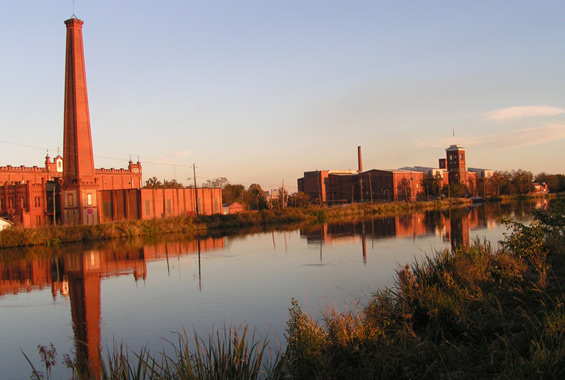
Would-be industrialists throughout the South Atlantic states took to heart such rhetoric, and from the 1830’s on, cities along the Piedmont uplift became, or strove to become, manufacturing centers. In Augusta, Georgia, the city financed the construction of one of the earliest power and transportation canals in the South, which created an industrial base still important to the area’s economy. For over 125 years the canal has supplied waterpower to the city’s textile mills and survives essentially intact, a credit to the engineers and men who built it.

Construction of the canal began in 1845, but the possibility of harnessing the Savannah River and building a power canal had been considered earlier. As early as 1828, the Augusta editor of the Georgia Courier debated the possibility of a power canal. [2]

In the 1820’s Augusta enjoyed unbounded prosperity because of its role as gateway to the frontier and as trade center for the exterior. The cotton trade had just become securely established. "A traveler who made a jigsaw journey from Charleston to St. Louis in the early months of 1827 found cotton ‘a plaque…’ At Augusta the thoroughfares were thronged with groaning wagons, the warehouses were glutted, the open spaces were stacked, and the steamboats and barges were hidden by their loads. On the road beyond, migrating planters and slaves bound for the West, ‘where the cotton is not worn out’ met cotton laden wagons townward bound, whereupon the price of the staple was the chief theme of roadside conversations." [3] The visits of Lafayette, Wilde, and other notables impressed the provincials so that in a little while they would think of the city as the "Philadelphia of the South."

The prosperity proved short-lived. Towns competing for the inland trade were platted along rivers and the railroads then being built across the state. Macon, Atlanta, and Columbus became regional trade centers in areas once claimed by Augusta, while across the Savannah River in South Carolina, Hamburg began stealing Augusta’s river trade and sending goods via railroad to Charlestown. After the enumerators filed the 1840 census, Augusta’s stagnation was revealed in statistical fact: the 1840 population equaled 6,403, or 293 less than in 1830. [4]

Augusta could not prosper while her tributary land was constantly deteriorating. "Major Jones," a fictional personage, mournfully described Augusta in these lean years of the early 1840’s: "[though it is] a monstrous pretty city, it aint the place it used to was, not by a grate site. It seems like it was rottin off at both ends, and aint growin much in the middle; and the market what a few years ago you couldn’t hardly see for the wagons, looks more like pretty considerable large martin-boxes standin in the middle of the grate wide street, than places of bisness." [5]

Attempts to reverse the trend of decline included traditional measures of building riverside warehouses or wagon roads west. Both failed to turn the tide.

In Augusta, the force of the industrial impulse struck at this time and was felt with increasing pressure throughout the country. The idea of manufacturing cotton textiles grew as more and more of the staple went north to industrial centers, which in turn sold the finished product to the South. Pointed editorials in the Augusta Chronicle asked why the city lagged behind, while Northern and even some Southern towns like Petersburg, Virginia, boomed as manufacturing centers. For example, after reprinting a description of the Lowell Canal system in 1845, editor James W. Jones wrote: "The man, or the set of men, who would transfer such a system [as Lowell’s] to the Southern States with its accompanying blessings, would do more for the real lasting benefit of our people than have all the mere politicians since the days of Washington." [6] The new campaign would be industrial, to make Augusta the "Lowell of the South."

Industrial precedents could be found along creek banks outside the city. Up Horse Creek, in South Carolina, the Vaucluse factory profitably produced osnaburgs as early as 1828. The Belleville and Richmond factories west of town began operations during the next decade and operated prosperous mill villages. Why couldn’t the Savannah River and its much greater power do even more for Augusta? As these mills appeared, speculations were whispered about harnessing the falls of the Savannah, a few miles above the city, and thus providing power sufficient for innumerable mills. In 1844, Henry H. Cumming, son of Augusta’s first intendent and a prominent lawyer, took it upon himself to ascertain the feasibility of a canal. [7]

Cumming was a member of one of the most distinguished families in Georgia; the son of the president of one of its strongest banks, the Bank of Augusta; the brother of Alfred Cumming, Augusta mayor, general in the Mexican War and later Governor of Utah; and brother-in-law of Reverend Samuel Stanhope Davis, the intellect behind Oglethorpe University. [8] He also served as director on the powerful Georgia Railroad and Banking Company. Cumming’s direct ties with Georgia’s economic and political hierarchy foreshadowed the success of his canal plan. Once convinced that the cure for Augusta’s economic ills rested on the construction of the transportation and power canal, Henry Cumming would manage its affairs from inception to conclusion.

In September 1844, Cumming privately took the first step and ordered a survey. [9] He hired the Georgia Railroad’s chief engineer, John Edgar Thomson, and Augusta surveyor William Phillips to determine the fall of the Savannah from Bull Sluice, at the beginning of the falls some six miles from town, to the mouth of Hawks Gully, or Augusta’s western city limit. Through the winter of 1844 the two surveyors ran their transit lines through the cottonwoods and briar patches along the river. Phillips, in a report published decades later, described the falls simplistically: "It has been determined by careful instrumental examination that the fall from Bull Sluice to the Hawks Gully is fifty-two feet. Hence we may consider the water of the river as flowing down an inclined plane of six miles in length, one end of which is fifty-two feet higher than the other." [10] This was more than enough to power cotton mills, more even than the fall at Lowell. Cumming was delighted.

Realizing that the construction of a canal would cost more than his private fortune, Cumming called for public support at a meeting on January 9, 1845, and met with a favorable response. William D’Antignac, president of the Bank of Augusta, pledged funds for a platting of the canal route. Senator John P. King, the nation’s youngest and most outspoken Congressional novice during the Age of Jackson, also gave the canal project his blessing and, more important, the support of the Georgia Railroad Banking Company. In all, the city’s four banks pledged $4,000 to pay for a permanent survey. [11] Editor James W. Jones gave his support as well by filling each issue of the Chronicle & Sentinel with articles describing canals and textile mills throughout the nation. Of Lowell, Massachusetts, his argument continued: "if it be not rude, we would suggest it as an example worthy of emulation." [12]

That January, their transits boxed and strapped to carriages supplied by the city, Thomson and Phillips headed back to the sand hills. A Pennsylvanian, Thomson grew up watching his father supervise construction of Philadelphia’s Delaware and Chesapeake Canal. Thus, not surprisingly, Thomson knew how to lay out an ideal canal system for Augusta. [13] According to historian Patrick M. Malone, "The ideal way to supply a number of mills with water power is to use a single canal running parallel to a river with a falls. If the canal leaves the river above the falls and reenters at some distance downstream, then the land between the canal and the river becomes an extended island on which mills can be placed in a line. By keeping the level of water in the canal close to that of the river above the falls, there will be a major difference in water level between the canal and the river at every point below the falls. Water from the canal can enter the mills on the island to drop through power-producing machinery, such as water wheels, and back into the lower river. In this way, the potential energy of the water due to its elevation, or ‘head’, can power manufacturing processes in each mill." [14]

Thomson’s Augusta Canal survey followed this ideal. A wing dam at the head of the falls would divert Savannah River water into the canal’s first or upper level. The route of the first level paralleled the river; an embankment would separate the two, while on the landside of the canal water would blow back, cutting a contour line from the surface of the ground. Near Rae’s Creek the canal route shifted away from the river and would flow through a U-shaped ditch 20 feet wide at the bottom and 45 feet wide at the water’s surface. The water would be five feet deep, dropping only 3-1/2 feet for the first level’s total length of 36,400 feet or nearly seven miles. [15]

Near the end of the first level and through corn fields on the edge of the city, Thomson surveyed two more levels, the "second level" and the "third level," paralleling each other and the first level. The canal’s configuration looked like a three-pronged fork with an off-center handle and prong tips bent until touching. Once the canal was completed, the water would flow down the first level to industries along its eastern bank, then fall through water wheels or turbines and come out at the second level 13 feet lower. From the second level the water again fell 13 feet through mill power machinery to the third level. The third level, actually a widening and connecting of Beaver Dam Creek and Hawks Gully, carried the spent water to the Savannah River. [16]

While Thomson and Phillips completed profile maps, Cumming prepared a construction proposal. During the 1840’s, however, the ideas of stock corporations and government-financed public utilities were imperfect. Cumming knew of the joint venture or stock company financing of canals, common in New England, as well as the government subsidizing of canals, predominant on the European continent, and combined the two ideas in his Augusta Canal proposal. A joint stock company, the Augusta Canal Company, would supervise construction of the canal, while the purchaser of its stock would be the City of Augusta. The city, in turn, would issue $100,000 worth of city bonds; transfer them to the canal company, who would then use the bond sales to finance construction. Furthermore, in exchange for a tax paid on city real estate, citizens would receive a proportionate amount of stock or "Canal Scrip." The plan straddled the legal domain of both a private corporation and the city government, but lawyer Cumming judged that all was legally sound. [17]

Months later the incorporation bill raised eyebrows in the Georgia legislature. One member called the bill "the strangest one he ever saw," and not until December 1845 did the legislature grant the company a charter. [18] In Augusta, some merchants and other property owners went to the local courts to contest the project’s legality in forcing them to be "stockholders," a dispute which, in 1848, the Georgia Supreme Court decided in favor of the canal’s proponents. [19]

This opposition faction had grown from the first and lost its strength only after a lengthy legal battle. Some feared that the canal would ruin the city’s pleasing appearance, but more stern complaints arose from merchants and warehouse owners who discovered that Thomson’s canal survey did not include locks for canal boats along the entire length of the canal. Instead, canal boats could float only to the end of the first level, where a new warehouse district might arise. Economic interests dictated their opposition, but most people could not comprehend the project, which was unprecedented on the Savannah. Literary character "Major Jones" reflected this latter sentiment: "I can see by the paper they’re gwine to dig a big canal, as they call it, and turn the river upstream into the common, so they can go into the mannyfacterin of cotton. That’s a sort of bisness I don’t know nothin about and I can’t say how it’ll turn out, but there’s one thing very certain, if the Augusta people don’t do something to start bisness agoing again, all the houses in the city won’t rent for enuff to feed ‘em." [20]

Realizing, like Major Jones, that the urgent need of Augusta outweighed any reasons for opposing the plan, a majority of the city’s businessmen approved the plan at a public meeting called by Cumming March 8, 1845. A week later, Mayor Martin M. Dye and the City Council gave the project their rubber-stamp approval, their one addition being that the canal also insure "an adequate supply of water for the use of the city." [21] The Council also requested the establishment of a Board of Canal Commissioners to manage financial matters. In a vote of confidence they appointed Henry Cumming president of the commission, while surveyor William Phillips received the only salaried position, that of secretary. Similarly, the people of Augusta showed an equal confidence in the lawyer by electing him head of the corporation owned by the scripholders.

Augusta’s activity attracted outside attention, and well wishers applauded the canal scheme. One Charleston newspaper optimistically declared: "It is hoped that this will be but the corner stone of a great structure, and that a light is about to spring up in the city of Augusta, which will illuminate the whole South…" [22] But newspaper rhetoric did not build canals. Thus, on April 3, civil engineer C. O. Stanford arrived to initiate construction, draw up formal plans for headgates, locks, culverts, and two aqueducts, and to sign an agreement promising to finish the job in one year for a $2,500 fee. (He did not know it, but he would still be at it two years later.) [23]

Paperwork precedes the digging. Chief engineer Stanford knew this and immediately sent out letters requesting bids from contractors. He followed Thomson’s plan and divided the canal into 12 construction sections numbered consecutively from the wing dam to the third level and through April concluded contract agreements. Judge Benjamin H. Warren signed the first, taking sections 6 and 7, which crossed his plantation, and by May had a force of hands and teams clearing the grade. James L. Coleman, Warren’s brother-in-law and neighbor, took sections 4 and 5, putting 10 slaves to work May 2. [24]

Contractors for the remaining sections came from the Georgia Railroad, whose construction methods used on the Augusta Canal resembled railroad construction techniques. Unfortunately, no description of canal construction methods appeared in contemporary newspapers. The Canal Commissioners Reports explain little. For example, on May 1, 1845, they reported hiring Timberlake and Timanus, Georgia Railroad workers, and their 60 hands and 18 carts. Other reports suggest that explosives were used to cut through rocky sections, that slaves and whites from the hills of north Georgia composed the labor force, and that masons from the North built the culverts, aqueducts, and headgates. In short, construction of the Augusta Canal was slow and primitive. [25]

After a year and a half, the approximately 200 workers completed the first level, and water flowed through the headgates on November 23, 1846. From the first level the water poured directly into the third level and out Hawks Gully to the Savannah River; the first boat passed through the locks three months later. [26]

During construction in 1846, the Canal Commissioners engaged George R. Baldwin of Boston to calculate the amount of water and the resultant horsepower available on the canal. With 5 feet of water, he concluded, the canal first level produced 380.36 horsepower from a discharge of 257.47 cu ft/sec, or enough to power two first-class 10,000-spindle cotton mills. The Commissioners agreed upon $5 per horsepower ($10 less than at Lowell) for water rents. [27]

The Augusta Canal, instead of creating an instant hoped-for industrial complex, only slowly lured industries to its banks. As last as November 1846, the editor of the Chronicle & Sentinel complained that "Augusta after two years still has nothing." The appearance of mills elsewhere in Georgia served as almost a rebuke to Augustans. Again, in his own words, the editor had "come to the conclusion that some communities (such as Milledgeville, Columbus, and Graniteville) have public spirit and enterprise-others ‘do the wind work’ ‘most elegantly.’" [28]

Augusta’s industrial ball did not get rolling until the appearance of Jacobez Smith, a manufacturer who had made Petersburg, Virginia, the South’s largest industrial city. Smith swept onto the Augusta scene, took charge of the Augusta Manufacturing Company, a corporation organized by Cumming, D’Antignac, King, and other canal backers but languishing for lack of direction. By June 1847 he had the first canal water right, a five-story building under construction, and machinery ordered from the North. The mill’s first year of operation proved so prosperous that in 1849 the company contracted for a second five-story mill. By 1851, able to run 20,000 spindles, the Augusta Manufacturing Company was one of the largest mills in the South. [29] Other mills followed, and laborers moved to Augusta. The population increased from 7,502 in 1845, when the canal was initiated, to nearly 13,000 in 1851. Reviewing the transformation of Augusta, William Phillips recorded, "It will be observed that in this brief period of five years [1845-1851] the assessed value of the real estate had increased $672,530-the increase of the city tax $5,039 and that the population has nearly doubled… Two large cotton factories employing a large capital and a great many operative-an extensive machine shop capable of executing any of the work for which we have hitherto been dependent on the northern workshops, and two large merchant mills have been erected on [the canal]…[thus ensuring] success in making Augusta as was at first proposed the ‘Lowell of the South.’" [30]

The project had proven a success, and even the national press agreed. The editor of the National Intelligencer of Washington, D.C., praised the progress of the city as evidenced by its industrial growth. No city was more alert to its future; and " ‘she is only beginning to feel the impulse which is urging her onward to influence and greatness.’ Not only were the manufacturers reaping a reward, the editor enthused, but planters were enjoying a new prosperity from the diversity of the needs of the growing urban population." [31] The industrial expansion of the city continued, the limit of growth determined only by the amount of water flowing down the canal.

To maintain the flow of water, however, required more than just the completion of the canal. For nearly a quarter of a century, William Phillips served as engineer for the canal, and his reports to the Canal Commissioners add insight into its operation and maintenance. When he took charge in 1848, he directed the completion of the second and third levels, which immediately caused a drain on the depth of water on the first level. The wing dam at the headgates, he decided, had to be raised and extended further into the Savannah. By 1850, he had crews bolting the finishing timbers atop the crib work dam, which increased the depth of the first level from 5 feet to 6 feet. To ensure that this increased water flow would not flood the city, iron gates were installed at Marbury Street (12th Street), which when closed reversed the current on the third level and caused the canal water to back up into Beaver Dam Creek and, eventually, into Phinizy Swamp, south of town. This flood outlet often saved from inundation. [32]

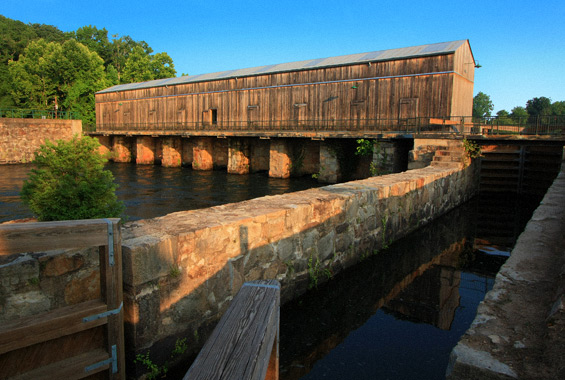
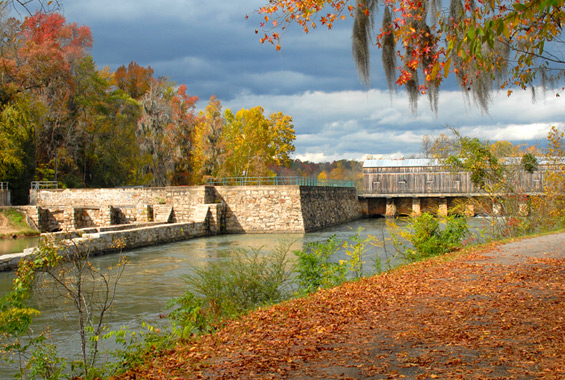
Among the more distressing failures on the canal were the aqueducts. Built of wood, the two structures-at Red’s Creek and at Rae’s Creek-soon began to lean and collapse. In 1848, Phillips tore down the Red’s Creek aqueduct, rebuilt the canal bank as a dam, and let the creek drain directly into the canal. At Rae’s Creek he sought another alternative. The wooden structure was removed in favor of a masonry structure built by Northern masons during 1850-1852. Though faced with granite from Stone Mountain, Georgia, and an attractive site for picnic parties, the Rae’s Creek aqueduct continued to leak. To Phillips, it was "a source of much anxiety and trouble." [33]

There were more anxieties: breaks in the canal bank, silt build-up, and users’ complaints of low water. Difficulties with the personnel compounded his problems. In 1857 he wrote, "In consequence of excessive inebriation of the Lock Keeper he had become so completely inefficient as to render it necessary to discharge him…" [34]

The Canal Commissioners, always with one eye on the budget, granted some aid. They allowed Phillips a dredge boat ordered from John Watchman & Co. of Baltimore-price $2,192.59. [35] As for the breaks in the bank, the 10-man work crew, costing some $5,000 to $6,000 per year, was inadequate. By 1856, the canal had cost the city over half a million dollars: in detail, 8% canal bonds $100,000, interest on same $44,000; 1847 canal bonds issued to complete first level $40,000, interest on same $28,000; six more bond issuances and interest for completing second and third levels, building the aqueduct, and extending the dam brought the total to $553,578.70. [36] And the canal only returned $4,149.60 per year in water rents. It was not a paying proposition, and the Commissioners deemed any enlargement of the canal a poor investment.

The Augusta Manufacturing Company, however, changed their collective minds. The company, as largest single user of canal waterpower, sued for more water; the flow received for their two mills rarely kept all mill machinery operating. The commissioners, many of whom were directors of the manufacturing company, granted more water, equaling a total of 463.84 hp, or one-fourth more than the total water power available on the first level. The commissioners found themselves in the uncomfortable position of explaining to other first-level industries the situation and, to avoid a legal battle, called in the firm of James B. Francis, Charles S. Storrow, and Charles H. Bigelow, of Lowell, Massachusetts, to examine the water power situation and act as arbiters. Bigelow arrived in mid 1856 and declared the city legally bound to supply all the first-level mills with more water. [37]

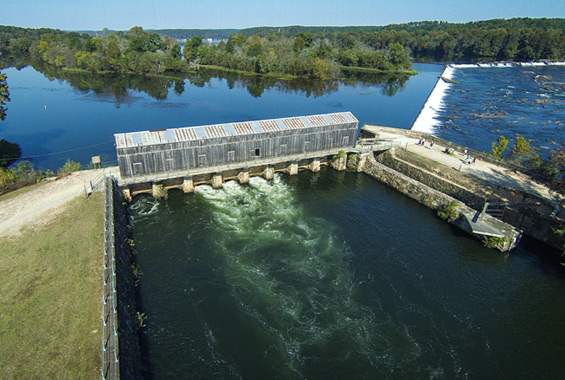
Between the fall of 1856 and October 1857, Phillips partially enlarged the canal to meet the necessary increase. First, he completed the wing dam, which had slowly been extended into the Savannah Channel, to the South Carolina shore. The rock and crib dam was built of locally quarried rock barged to the site. The resulting diversion of more water caused the depth of the canal’s first level to reach 7 feet. The canal bank was added to and capped with stone and timber riprap in order to hold back the new supply. The headgates, although essentially left unchanged, had the worm gearing on the gates replaced with rack-and-pinion gearing, making it easier to raise and lower the wooden panels. Black laborers paid 85¢ per day and Irish laborers paid $1 per day composed the work force of around 50 men. [38]

The Augusta Manufacturing Company required nearly all the new waterpower generated on the first level, but on the second level promising sites became available. In 1859, August merchant Alfred Baker built the four-story brick Paragon Flour Mill. [39] Nearby, the City of Augusta erected a pumping station and city water works, the first of three to use canal power. [40]

The enlargement also prepared the city for the Civil War, which brought a spurt of industrial activity to Augusta. Because of its central location and easy access, the Confederacy recognized the potential of Augusta and made it an "indispensable center for the manufacture of gunpowder and an important supply center for the Ordnance, Quartermaster, and Commissary Departments of the Confederate Army and Navy." [41] The Confederate Powder Works, stretching for two miles along the canal bank and constructed between 1861 and 1863, was the most tangible example of growth caused by the war. Although the physical shape of the canal changed little, the number of manufacturers along it doubled, especially on the second level where a pistol factory, government bakery, dye plant, and other war-oriented factories clustered. An English visitor in the autumn of 1862 conceded that "Augusta really begins to look like a little Lowell." [42] Unfortunately, once the war came to a halt so did many of these industries.

Through the remainder of the 1860’s, the city government languished in dire economic straits and debated selling the Augusta Canal. The then-prosperous Augusta Factory offered to buy it under the condition that the company alone could use waterpower from the first level. Opposition to such a proposal came largely from business leaders outside the Augusta company who foresaw it as a restriction to future industrial growth. Engineer William Phillips continued to urge that the city enlarge the canal, and in 1869 Mayor J.V.H. Allen echoed the sentiment in his inaugural address: "The question of the enlargement of the Augusta Canal has been respectfully referred to you by your immediate predecessors. They are of the opinion that this public work contains the germ of the future greatness of our city, and needs only to be developed to bring a large increase of industrious population, millions of additional wealth and profitable labor for our poor." [43] In 1870, Charles Estes, an Augusta banker-merchant and one-time contractor on the Genessee Valley Canal in New York, campaigned on a canal enlargement platform and after his election as mayor initiated its survey and construction. In October 1871, the citizens of Augusta voted overwhelmingly in approval of the project; the canal would be funded by the sale of city-held railroad stock, some $200,000 worth, and by a city bond issuance.

Estes hired Charles A Olmstead, an ex-Erie Canal engineer, to supervise initial construction. The enlargement would only increase the width and depth of the first level, but the increased water power would make available mill sites with a fall of 32 feet or more. The canal’s new dimensions would be: minimum waterway, 150 feet at surface, 106 feet at bottom, and 11 feet deep, making an area of cross section 1,408 square feet. An estimated 12,000 to 14,000 horsepower could be generated, enough waterpower to turn the machinery of 10 cotton mills the size of the Augusta Factory. Olmstead also planned to dam Rae’s Creek, which would create a reservoir now called Lake Olmstead. Somewhat boastfully, one contemporary called the enlargement "a work in width and depth in excess of any similar work in the world, save the Suez Canal." [45]

By March 1872, the New York construction firm of John A. Green & Company had shifted their work force from the Erie Canal to Augusta. They used a steam-powered dredge, vertical steam "donkey" engines, and other updated equipment to dig the canal, quarry stone, and take dam materials across a narrow-gauge track to the Savannah River. Task labor (temporary labor hired for a single task) and skilled laborers did the masonry work or operated the heavy machinery. Italians did the precise stonework on the Rae’s Creek aqueduct-soon to be dam-while the backbreaking menial labor was performed by convict labor crews made up mostly of blacks, and by Chinese "coolies," recent arrivals in the country. One editor, though awed by the massive project, found the Chinese the most curious as well as industrious, "working with a zeal and an energy which are as creditable to them as they must be gratifying to the contractors." [46]

In November 1873 the Augusta press reported the canal grade and embankment nearly completed, while work on the new dam, lock and headgates would begin as soon as water power demands increased. Already there were signs of new demand. During 1873, Russell & Simmons’ 1,000-spindle cotton mill and waste factory was built on the first level, the first mill to use the new 32-foot fall or "head." George T. Jackson & Co., owners of the Granite Flour Mill, doubled their plant’s capacity with a brick addition, and the Augusta Factory broke ground for mill #3. Though no new large-scale industries appeared at this time, these accomplishments alone were enough to bolster local optimism, especially since the national financial panic of 1873 had crippled industry elsewhere. [47]

Pleased with Augusta’s outlook, Mayor Estes proceeded with the construction of the new headgates, lock, and dam. Byron Holley, another engineer off the Erie Canal, supervised this work. The stone masonry headgate had 17 slide gates, easily operated by one man turning the rack-and-pinion gearing. The lock measured 100 feet by 15 feet and had mitre swing gates, patterned after those in use on the Erie and other canals in New York. By May 1875 Holley had completed the work and left to supervise construction of the nearby Vaucluse Cotton Mill, while the City Council completed the official paperwork accepting the canal. On May 21, 1875, they formally approved and accepted the enlargement of the canal. [48]

The canal enlargement had cost the city $972,883.15, or over twice original estimates, and, worse yet, because of the continued depression of the 1870’s, it only slowly effected the growth industry. Visitors to the city did comment positively on Augusta’s "life and energy worthy of the brightest of Northern cities of its size." Similarly, handbooks and guidebooks to Augusta praised the canal as a "great work," but within two years of its completion only one small cotton mill, the Globe, had been built. [49]

Not until 1877, when national money markets began to loosen up and cotton market values began to increase, did prosperity return. In Augusta, boosters of the Augusta Canal enlargement combined with flour mill owner George T. Jackson to form the Enterprise Manufacturing Company, the first large-scale cotton mill to use the increased water power. In 1878 it began production and within three years had proven such a success that stockholders voted to double its size and declared a 10% dividend worth $50,000. The success of the Enterprise Mill and the low water rates-the city offered it at $5.50 horsepower-attracted other mills. The Sibley Manufacturing Company built one of the most ornate mills in the South, let alone Augusta; next door, the John P. King Manufacturing Company, headed by Charles Estes, hired mill architect John Hill to design its mill, Augusta’s largest. Two cotton factories took over the old Russell & Simmons mills and rebuilt it as the Summerville Manufacturing Company. These mills, along with the Augusta Factory, the Globe (later Blanche) Mill, and the steam-powered Riverside Mill adjacent to the Savannah, composed Augusta’s seven largest cotton mills. [50]

The canal and cotton mills created a need for associated interests. To repair machinery for the mills and canal, the George R. Lombard Iron Works expanded from two small canal-powered foundries, the American Foundry and Forest City Foundry, into one of the largest plants in the Southeast. During the 1880’s, the Dartmouth Spinning Company (later Sutherland Mill) and Shamrock Mill were built to supply the other mills and outside markets with odd thread sizes and yarn. Cotton seeds, used by the textile mills, went to the Augusta Cotton Seed Oil Company, the old Paragon Mill on the second level, where they were processed. Other industries using canal waterpower included the Augusta Street Railway Company and the city’s new water works, built at the end of the first level around 1885. [51]

The cumulative success of the new industries and the continuous boasting of the Augusta press convinced Augustans that the city was leading the New South away from the bitter war years and the unpleasant Reconstruction era. "Keeping pace with the new South," wrote the Chronicle, "is the new Augusta, outstripping competing neighbors and fast establishing herself as the queen city of the Savannah Valley and the greatest inland and commercial manufacturing center in the South Atlantic States." [52]

The Chronicle was not alone in its praise, however. Harper’s Weekly and Leslie’s Illustrated Newspaper, both of New York, contained full-page descriptions and illustrations of the "Lowell of the South." Even a conservative book on Georgia’s industrial growth published by the Department of Agriculture claimed "Augusta is third in size in Georgia, and ranks first in the south in the manufacture of textile goods." [53] The town’s population had increased from 15,389 in 1870 to 33,300 in 1890, among who were some 4,000 workers in the local cotton mills. The City Council was also pleased since revenues from water rent equaled some $100,000 annually, which was paying off the canal debt with funds to spare. The canal had fulfilled the dream of its projectors. [54]

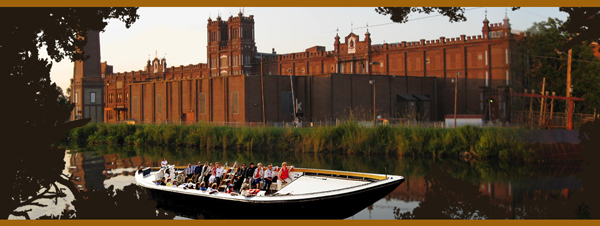
The canal served other functions besides the powering of machinery. Picnic parties and excursionists found pleasant retreats at the headgates and locks and the Old Rae’s Creek aqueduct-pronounced "ackyduck" by locals. On the first level, boats ranging in size from one-man canoes to the 100-person capacity "Dolly Varden" floated back and forth from the canal basin to the locks. The "Petersburg Boats," specially designed barges some 70 feet long and 5 or 6 feet wide with a six-man crew, were the most common on the canal, carrying cotton and other goods down from Petersburg on the Savannah River. Each company along the canal usually had its own barge and, in cases, a small steamboat. [55]

Lake Olmstead too became a recreation center. Sailboat and rowboat races around the small islands competed with swimming and other attractions along the shore. The Lake View pavilion along its shore was the place to be at the turn of the century.

But the canal could turn pleasure into tragedy. An overgrown granite headstone on the canal bank near Rae’s Creek reads: "Here on the 10th day of March 1891 were drowned Louise King Connelly and Henry Cumming Lamar."

For nearly half a century, roughly 1880-1930, the canal demonstrated the correctness of its proponents’ planning. Twelve major industrial complexes used the waterpower and paid the city nearly four million dollars, while yearly maintenance costs rarely exceeded $20,000. Yet the first years of the 20th century corresponded with a change in ideologies of the city’s fathers. The change of the city’s nickname reflected the new attitude; no longer the "Lowell of the South," Augusta became the "Garden City." This urban progressive reform movement took tangible form on the Augusta Canal at the 13th Street headgates, with their ornate posts and flower pots, and the Archibald Butt Memorial Bridge. The latter, however, because of its shape, nearly ended barge traffic on the canal. By 1912 and the construction of the Butt Bridge, the Augusta Canal showed signs of its age. Boosters and progressive spirits saw it as a relic of an outdated age and suggested modernization. As early as 1906, public proposals were made to abandon the lower end of the canal and build one central hydroelectric plant on the first level. [56]

Also, since the turn of the century, the Augusta Canal has slowly deteriorated. By 1905 all of its waterpower was contracted for, but the city, instead of continually revitalizing the canal, completed major reconstruction projects only after floods had destroyed banks or fixtures. This flood response experience has occurred in 1908, 1929, and 1936. The former forced the city to rebuild the 13th Street headgates and to build the guard gates and levee, while the latter floods created the need to build a new bulkhead and guardwall at the dam, totally reconstruct the configuration at Rae’s Creek aqueduct and spillway, and rebuild much of the canal bank. The Works Progress Administration supplied the labor and much of the funds during the 1930’s. When withdrawn from the work in 1941, anything they left uncompleted, such as a new spillway above the waterworks, remains uncompleted. [57]

The construction of Clark Hill Dam on the Savannah above Augusta has relieved the residents of any fear of major flooding, and thus the canal has continued to deteriorate. Headgate arms have broken, gates have rusted fast or fallen down entirely, and the once-flowing second and third levels have become choked with overgrowth. Also, sections of the second level have been covered or filled in, its route still traceable as an alleyway between oddly shaped property boundaries. The first level continues to power the city water works and hydroelectric units in the Sibley, King, and Enterprise mills, but even this may end if negotiations with the Georgia Power Company transpire. Then the canal will end at a hydroelectric plant near Rae’s Creek. [58] The other industries slowly went out of business during the Depression or cancelled their waterpower contracts because of poor service and high capital outlays required to refurbish old power plants.

During the 1960’s and 1970’s, the physical form of the canal and the adjacent industries changed greatly. Every industry on the second and third levels, which once ran by waterpower, stopped using their turbines. Many mills were closed and torn down: the Augusta Factory (1847-1962), the Augusta Machine Works (Augusta Lumber Company) (1850-1974), the Cunningham Flour Mill (Clark’s Flour Mill) (1848-c. 1960), the Augusta Railway Company’s power station (Georgia Power Company) (1890-c. 1975), Russell & Simmons Mill (the "old silk mill") (1873-1977). Other mills along the second level stand idle, with uncertain futures: the Paragon Mill (Standard Bagging Company) (1959), the Globe Mill (Blanche) (1876), and the Georgia Iron Works (1890’s). The future of Augusta’s power canal is indeed bleak.

From its completion in 1847 through the turn of the century, the Augusta Canal acted as an umbilical cord for Augusta’s developing industries. As they grew, some left the fold for larger plant sites on the town’s edge, while others reduced their dependence on the canal and shifted to other power sources. Yet all had contributed to making Augusta an envied manufacturing center. Indeed, during the 1880’s the canal and the mills along its banks served as example for the rest of the South. Though the city never had the extreme industrial concentration of Northern cities, the canal made Augusta one of the most conscious imitators of the canal water power systems of such cities as Lowell, Massachusetts. In this sense, Augusta was truly the "Lowell of the South."


Footnotes

Back to Top


Bibliography


Home

Contact